Democratic deficit
Dutch nationality does not automatically grant you the right to vote in Dutch parliamentary elections.


How people in the Dutch Caribbean experience the democratic deficit
Within the Kingdom of the Netherlands, not all people feel equally represented.
In the Caribbean part of the Kingdom, on Curaçao, Aruba, Sint Maarten, Bonaire, Sint Eustatius, and Saba, many people feel that there is an unequal distribution of power and influence between the islands and the European Netherlands.
This difference in political influence is known as the democratic deficit.
The CAS Countries: Autonomy without real influence
In the countries of Curaçao, Aruba, and Sint Maarten, there has been a feeling for many years that the Netherlands still has too much control.
Important decisions about issues such as defense, foreign relations, and financial agreements are made in The Hague, while the islands have little direct influence over these decisions.
The islands have their own parliaments and governments, but they do not have representatives in the Dutch House of Representatives.
This can make it seem as if the autonomy promised in the Charter (locally referred to as the 'Statuut') of 1954 is limited in practice.
Many people feel that the Netherlands too often acts as a supervisor instead of as an equal partner. Institutions such as the Board for Financial Supervision (Cft), or Dutch intervention in local government, are sometimes seen as forms of continued colonial control. At the same time, some people understand the Dutch role. They see the Netherlands' responsibility to protect good governance and human rights as an important safeguard. Still, the main problem remains the same: there is equality on paper, but not always in practice.
The BES Islands: Influence without real independence
The situation is different on Bonaire, Sint Eustatius, and Saba. Since 2010, these islands have been public entities of the Netherlands.
Their residents can vote in elections for the Dutch House of Representatives.
However, many people feel that their vote has little influence because the islands are so small compared with the Netherlands as a whole.
Decisions about local issues are often made in The Hague, sometimes by politicians who have little knowledge of life on the islands.
The dissatisfaction was especially strong on Sint Eustatius. In 2018, the Dutch government took control of the island's local government because of what it described as serious problems with governance. For many residents, this felt like a step backwards. It felt as if The Hague had once again taken control of their island.
Two Sides of the Same Problem
The differences between the islands are clear:
- The CAS countries have autonomy, but little influence in the Netherlands.
- The BES islands have political influence through Dutch elections, but little autonomy.
Yet the feeling on all the islands is similar. The distance from The Hague is not only a matter of kilometers. It is also about understanding, having a say in decisions, and being treated as an equal. The democratic deficit is therefore not only a political issue. It is also about trust and about the feeling of belonging together within one Kingdom.
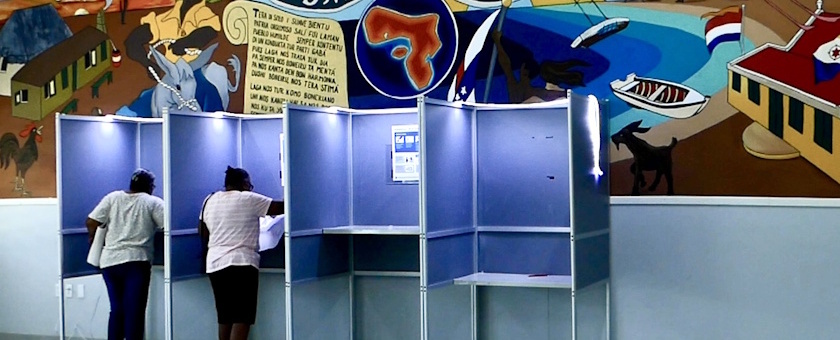
The democratic deficit: Voting rights
In the Caribbean part of the Kingdom, people have Dutch nationality just like people in the Netherlands.
However, their influence on decision-making within the Kingdom is limited.
Important issues such as defense, foreign relations, and some financial arrangements are decided in The Hague.
People in Curaçao, Aruba, and Sint Maarten, known as the CAS countries, can only vote in elections for the Dutch House of Representatives if they have lived in the Netherlands for at least ten years or have worked for the Dutch government.
This means that people who have never lived in the Netherlands cannot take part in national elections, even though they have Dutch nationality.
This difference shows what is often called the democratic deficit: the countries are formally equal, but in practice they do not have equal political influence.
The Netherlands gives several reasons for this restriction:
- Autonomy of the CAS countries: They have their own parliaments and governments that are responsible for most domestic matters. The Dutch House of Representatives mainly represents the people living in the European Netherlands.
- Connection with the Netherlands: The requirement of ten years of residence or government service is meant to make sure that only people with a clear connection to the Netherlands can influence national politics.
- Political balance: The laws made by the Dutch House of Representatives apply almost entirely to the Netherlands itself. If everyone living on the islands could vote, this could change the political balance because their interests are often different from those of people in the Netherlands.
For Dutch citizens who move to other countries, such as Canada, the United States, or other European countries, this ten-year rule does not apply. They can vote for the Dutch House of Representatives if they have previously been registered in a municipality in the Netherlands and later register as a Dutch voter living abroad. Their children who are born outside the Netherlands and have never been registered in a Dutch municipality do not have voting rights.
People living on the BES islands (Bonaire, Sint Eustatius, and Saba) do have full voting rights. This is because these islands are public entities of the Netherlands and their residents are directly registered in a Dutch municipality.
The democratic deficit shows that having autonomy on paper does not automatically mean having equal political influence. The CAS countries are part of the same Kingdom and their people have the same Dutch nationality, but their influence on the most important decisions within the Kingdom remains limited.